Welcome to my own site for personal improvement, which I call transformalism, as explained in more detail in The Tyranny of Being (see on-line store). Thousands of years ago, the ancients knew that what we put into our bodies had an effect on our physical well-being. You are what you eat, the old saying goes. Yeah, yeah, everybody knows that, you say... but there are many beliefs that we profess to hold, yet completely forget about when we make the decision in our lives. We all know that what we put into our bodies has an effect on our physical (and mental, emotional, and spiritual) well-being, but look at the junk that we continually put into ourselves. We put trans fat- and cholesterol-laden foods into our bellies - ultimately into our arteries - and wonder why we end up with cardiovascular disease. We put tons of refined sugar into our bodies and wonder why we get diabetes. We shovel garbage into our bodies at an alarming rate, and then wonder why we don't feel well and why our bodies cease to function as they should. So getting back to the fundamentals is important.
Consider the following passage:
The King spake unto Ashpenaz the master of his eunuchs, that he should bring certain of the children of Israel, and of the king's seed, and of the princes; Children in whom was no blemish, but well favoured, and skilful in all wisdom, and cunning in knowledge, and understanding science, and such as had an ability in them to stand in the king's palace, and whom they might teach the learning and the tongue of the Chaldeans. And the king appointed them a daily provision of the king's meat, and of the wine which he drank: so nourishing them three years, that at the end thereof they might stand before the king....But Daniel purposed in his heart that he would not defile himself with the portion of the king's meat, nor with the wine which he drank: therefore he requested of the prince of the eunuchs that he might not defile himself... And the prince of the eunuchs said unto Daniel, I fear my lord the king, who hath appointed your meat and your drink: for why should he see your faces worse liking than the children which are of your sort? then shall ye make me endanger my head to the king. Then said Daniel to Melzar whom the prince of the eunuchs had set over Daniel, Hananiah, Mishael, and Azariah, Prove thy servants, I beseech thee, ten days; and let them give us pulse* to eat, and water to drink. Then let our countenances be looked upon before thee, and the countenance of the children that eat of the portion of the king's meat: and as thou seest, deal with thy servants. So he consented to them in this matter, and proved them ten days. And at the end of the ten days their countenances appeared fairer and fatter in flesh than all the children which did eat of the portion of the king's meat. Thus Melzar took away the portion of their meat, and the wine that they should drink; and gave them pulse.
Daniel 1:3-16 (KJV)
Why did I choose this particular Biblical passage as our theme? For several reasons:
- It shows that knowledge about food and nutrition is not new - the knowledge of what is good for us goes back thousands of years. The ancients were very enlightened in knowing the danger of too much meat consumption, too much alchohol, the value of drinking water, and the need for protein and fiber (in the form of legumes mainly).
- It shows that there's a natural law of cause-and-effect between what we eat and our health, and the consequence of over-indulgence.
- It shows that we are not powerless to changeo our lives. We do have the means of self-improvement, indeed self-improvement is a duty for we cannot serve our fellow man and be good witnesses for God if our bodies are not as strong as they could be, and if they bear the marks of a lack of discipline.
This passage from the Book of Daniel bears striking resemblance to the idea of karma in Eastern religions--we sow what we reap. Weight loss is just one area we struggle with in our lives, but the principles that apply here can also be applied to all other challenges of the will that we face.
Philosophy of Self-Improvement Here we will have a few things to say about our philosophy of self-improvement. This may seem somewhat metaphysical at first, but it has practical outworkings that we'll get to.

The Nature of Man Man has many parts to his nature. Some divide him into two parts (body and soul) or into three (body, soul, and spirit). For our purposes here, we consider human nature as coexisting in four realms - the physical, emotional, mental (or intellectual), and spiritual. All four are crucial to our existence and well-being as human beings. Some philosophies overemphasize the spiritual and treat the physical as depraved and illusory. Some emphasize the phyiscal and ignore the spiritual aspect of our nature. Some give too much weight to the emotional or intellectual sides of our nature. But man is an integrated whole, and our well-being and proper functioning as human beings depends on our being well-rounded and functioning in all areas of our lives. Problems occur because of an imbalance in these four aspects of our nature. What does this have to do with self-improvement? The imbalance in our parts is what causes all kinds of character disorders, such as addiction. we'll use the example of being overweight, but it could as easily apply to smoking, alcoholism, drug use, promiscuity, etc. Quite often is someone has fought being overweight his or her whole life, there's an underlying (often emotional) issue. That person may have been abused or molested, may experienced childhood trauma, may have very low self-esteem. Usually the weight loss focuses on the physical aspects of nutrition and exercise, but until the underlying isseus are dealth with, permanent weight loss cannot occur. The overeating will continue as long as our self-image is suppressed and as long as we have a void in our nature that needs filling. Dealing with the problems in our lives therefore must involve first and foremost dealing with our mental, emotional, and spiritual stumblingblocks that prevent us from being an integrated whole. 
Guilt, Self-Esteem & Moderation If you accept this idea that all our parts have to be fully-developed and in balance, that naturally leads to the concept of moderation in all things. This is referred to in Western philosophy and in Eastern religions as the Law of the Golden Mean. Simply put, life is about balance and putting too much emphasis on any one aspect of life leads to unhealthy excess, so the key concept is one of moderation. We may seesaw in our eating habits from binging to starving ourselves, all our of guilt at having overindulged. Self-esteem is another example. People can have too much self-esteem or too little. Having too much self-esteem causes us to be vain and selfish. Having too little makes us feel worthless and incapable of changing our lives. The best course is one of moderation - we should neither esteem ourselves more than nor less than our fellow man. We are no worse than that greatest monarch and no better than the humblest beggar. That means seeing ourselves as we truly are, and being able to free ourselves from the destructive power of guilt and shame. The true story is that there is good and evil in all of us, and since we are created in the divine image we have the power within us to re-create and transform our lives. Some suppose that we can do everything in our own humanity without being in connection with God (i.e., without having the spiritual side of our nature developed). Others suppose that we cannot do anything for ourselves, that we are helpless and need God to do everything for us. Both extremes are wrong. We need God's presence in our lives as a source of inspiriation and power, but we must also strive towards and work through our own transformation. To restore the balance in our lives means we have to let go of the guilt and shame that causes so much of the self-destructive behavior we know we should not engage in, but we do in an effort to punish ourselves for our perceived worthlessness. Letting go will allow you to see both your strengths and your shortcomings clearly, which is the prerequisite for change. It was this realization and this letting go of my own baggage that led me to my transformation.
|

The Problem is in Your Mind
No matter how much you diet and exercise, no matter how many times you crash and burn, you will never succeed in transforming yourself until you address your mental stumblingblocks. We are victims, most of us, of defeatist thinking, setting us up for failure before we even start to take the steps to change our lives. We say, "I'm going to make a half-hearted attempt at losing those extra pounds, and if I don't lose ten pounds the first week I'm going to give up." We make the mistake of giving ourselves an option for failure, and an excuse for giving up. But, my friend, all excuses ever do is make us feel better about failure; they can never produce life-transforming reuslts.
You have to want to succeed. You have to want it with an all-consuming passion that is stronger than all the reasons you have not to do it. Write down all the reasons on one side of a sheet of paper why you want to lose weight or quit smoking; write down all the reasons on the other side why you should not. Think long and hard about what's keeping you in your current cycle of self-destructive behavior. I'll bet your list of reasons to change is far longer than your list of reasons not to change. Then consider what other ways you could meet your legitimate needs that your self-destructive behavior is feeding.
You have to generate positive energy in your thought life. Everytime people in your life tries to discourage you, and tells you a hundred reasons why your venture won't succeed, you need to distance yourself from them. That's a tough one, but you absolutely need to surround yourself with positive and upbeat people who will encourage and edify you. As soon as you start having thoughts that are self-defeating, banish them from your mind. Refuse to give any credence to the little voice telling you a thousand reasons you'll never suceed. That voice is the voice of guilt and shame, and it'll tell you things like, "I'm too weak," "I'm too stupid," "My luck will never change." Tell it to shut up.
That's why I like this image of the nautilus spiral above. It is a symbol of the mysterious order and symmetry in nature, a powerful reminder that God designed us with a purpose in mind. This also illustrates the cycle of creation and destruction. Think of yourself as being in the center of teh spiral, and the universe and everything in it being in the outer reaches. Life is a process of growing in connection with our fellow man, our world, and God. We start out selfish and limited in the center of the spiral, and as we mature our viewpoint changes and our consciousness - if we develop as intended - expands. We cannot stay constant in our development, for life is a state of constant change. We have two choices: we can either send positive energy out into the world (through encouraging, hopeful, loving thoughts, words, and deeds) that enriches our fellow man, or we can send negative energy out (discouraging, despairing, hateful ones) that makes us a scourge to our fellow man. The choice is ours. The difference is whether we are a blessing or a curse on humanity, whether we suceed or fail, whether we are kind and generous or selfish and grasping.
The Process of Self-Improvement
God helps those who help themselves!
Enough philosophizing; what you really want to know is how to transform your life. At the bottom of this page, you'll see my story, which you can use as a guide on your own journey to the promised land.
Thought is the source of everything that happens in our lives. We are the masters of our own fate; we create our own destiny. We either send out positive or negative energy and what we send out comes back on us (the law of consequences). So the first step must be to change our thought life.
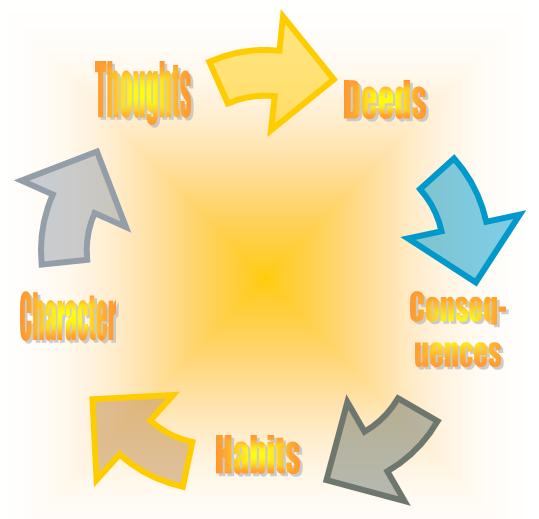
Thoughts lead to deeds. Deeds have consequences, whether good or bad. Our actions and their consequences define behavior, which can become crystallized as habits. Habits shape our character. Character gives rise to thought which starts the cycle over. If we engage in negative and destructive thinking, we spiral inwards in a cycle of selfishness. If we engage in positive and constructive thinking, we spiral outward in a cycle of expanding awareness and connection with our fellow man, nature, and God. As St. James
Every man is tempted, when is is drawn away of his own lust, and enticed. Then when lust hath conceived, it bringeth forth sin: and sin, when it is finished, bringeth forth death.
James 1:14-15 (KJV)
Though we can try to change our behavior, it cannot have a lasting effect, because we are not focused on the fundamentals - our thoughts and desires that are at the root of all our actions. Changing the outer behavior without changing the inner man is doomed to failure. To succeed, we must engage in self-awareness to see ourselves as we truly are, then interrupt the cycle and stop the inward negative spiral.
The steps, therefore, are summarized below. I have found that these principles work no matter whether you are battling overeating, anger, or other demons:
-
Be self-aware - know your strengths and weaknesses and admit to yourself that you are struggling in an area of your life. Be brutally honest with yourself.
-
Decide to commit yourself whole-heartedly to change in that area of struggle.
-
Devise a detailed plan, with short-term goals on the way to your ultimate goal.
-
Do it - if you fall flat, get right back up and try again.
That's it - decide, devise, and do. The 3 D's. The actual execution will require a lot of will and effort, but most of what we want we fail because we fail to (1) completely commit to the task, (2) develop a detailed and practical plan for getting there, or (3) give up when things get a little difficult. Remember a few facts in all of this:
- You do not need to be in bondage to guilt and shame; failure is temporary and has a bright side to it; it is an opportunity for learning and growth.
- Remember that God in His infinite wisdom created you an imperfect being, whose destiny is to strive and work towards perfection. Give yourself permission to fail and don't beat yourself up for being imperfect.
- If something isn't working, change your approach. If at first you don't succeed, try something else.
Once you have developed your plan, the key steps to putting it into action are the same no matter what demon you're fighting. The steps that follow being motivated and having a plan come from the cycle up above:
self-analysis (knowing our strengths, weaknesse, and goals)
interruption (stopping the cycle before thought gives rise to actions)
channeling (putting our self-destructive tendencies into constructive pursuits)
That's basically all there is to it. We humans make things harder than they really are so as to rationalize our lack of effort to ourselves. But rationalization is not justification. Look at weight loss, as our key example. Losing weight is neither conceptually complex (just take in less calories than you burn), nor difficult (exercise and don't eat as much). Yet we make it difficult...at least the vast majority of us who don't have an underlying medical disability.
I hope soon to have an E-book on applying these principles to weight loss and anger management. Please stay tuned.
My Story
For my entire life, I've had a bad temper; the only emotion I would show to those around me was often anger. And I fought the battle of the bulge for most of my life. I was sedentary and ate poorly, and had developed high blood pressure and was growing old before my time. My life seemed as though it was on the wrong track, with things just not turning out the way I'd thought or hoped they would. This is the story of my descent into darkness and long climb back out. I hope that it brings hope and insight to those of you who may be treading my same journey.
The Descent
Like many people in our society, I’d struggled with my personal demons my whole adult life. Like many of us, I’d learned unhealthy dietary and exercise habits from my youth. Though I grew up on a farm, where there was no shortage of work, and spent much of the time outdoors, exercise was sporadic. There were few other children around, and I was an awkward and withdrawn youth, and consequently also had a notoriously bad temper. During the summer between junior high and high school (my motivation was changing schools), I managed to lose a great deal of weight and got myself in shape for the first time in my life. But it did not last, as I did not make the connection between changing my habits and keeping the weight off. My unhealthy lifestyle was cemented in college – college students sleep late, spend too much time sitting and studying, and eat way too much late-night pizza. When I moved into adulthood and started a family, these problems continued to worsen. Times were tough when we were first married, between health and financial pressures; my temper continued to worsen and my weight continued to climb.
That was the situation in 2006 – 2006, when I’d finally had enough. I began to look at my life and saw that it was moving on the wrong track. Despite having a prestigious job, a doctorate, and our own home filled with healthy children, there was the unshakeable sense that something was missing. It seems clichéd to call this period of darkness the onset of a midlife crisis, but that’s exactly what it was. To make mattes worse, I had started to drink, not so much to drown the emptiness as to give me an excuse to release the rage and bitterness that was welling up within me. My temper was worsening, my weight was pushing 300 pounds, and my health problems – hypertension, shortness of breath, indigestion, insomnia, back pain, etc. – were mounting. I hated my life and was sunk a deep depression. And on top of that, I’d begun to question why God was allowing me to go through this valley. I did not question the existence of God, but rather why I felt so abandoned. My God, my God, why hast thou forsaken me? I’d always driven myself to perfection and ruthlessly excoriated myself for not being perfect. Being obese and so out of control and filled to the brim with a dark and murderous rage flooded me with guilt and shame.
The Ascent
Then I woke up from the bad dream one day and decided I’d had enough, that I refused to allow myself to live this way a moment longer. We’d been to counseling because of some of the turbulence in our lives, and it gradually became clear that the root of much of the trouble lay in my notorious temper. A book was suggested that opened my eyes. It was The Anger Workbook by Lorrainne Bilodeau. Working through this book, learning as much as I could about the phenomenon of anger, and mostly by my own struggles with the inner dragon, I came upon the aforementioned principles of self-examination, interruption, and channeling my energy constructively. I learned the crucial connection between our expectations of reality and the frustration that culminates in anger, that having an angry temperament was the direct result of there being too large a gap between my expectations of life and the reality thereof. Once I realized this, the next step was laid out plain to see before me. The key to not being angry is simply in lowering our expectations of reality. This truth exists in Christianity, being implicit in the doctrines of humility and faith, but is more fully expressed in Hinduism and Buddhism, in the doctrine of renouncing desire, in dukkha and tanha. Once I realized that truth my anger began to drain away. But putting these three principles of ruthless self-examination, interruption and channeling (or sublimation) into action, and consciously lowering my expectations of life, I conquered the demon that had plagued me for my whole adult life. At first that required a lot of discipline, but after a while the new habits began to be engraved in my character. As a result, where once I was a fire-breathing dragon I am now as gentle as a lamb (though this lamb roars, but at least does not belch flames from time to time).
The same principles that governed the conquest of my legendary temper helped me to conquer my lifelong battle of the bulge. In early 2006, I made the fateful decision that I would sever the gastronomic ties with my family and permanently change my eating habits. I was educated and knew how I should be eating, yet we were doing as most people in our culture do and eating a diet too rich in meat, refined carbohydrates, fat, and cholesterol. I decided that I would cook for myself and cut out most meat, replace refined carbohydrates with whole grains and cereals, and eat a lot more vegetables. I basically decided to put the recommendations of the Food Pyramid to the test. And over the next year and a half, the weight slowly started to come off. There were of course a few setbacks along the way, and I would backslide from time to time, losing a few and gaining a few. That gradually settled down as I learned to become more self-disciplined and refined by eating habits, so that by September 2007, I’d managed to lose about fifty pounds off my top weight.
This is the diet that I found worked to not only lose weight but also dramatically improve my health and my energy level:
· Cut back dramatically on meat, eating meat (usually chicken or fish) on average every other day
· Replace protein from red meat with egg whites, yogurt, and assorted legumes
· Give up most starches and refined carbohydrates, replacing them with whole grains, cereals, and beans
· Drink lots and lots of water, and lots of green tea and coffee (such a use of caffeine is controversial but does speed the metabolism)
· Eat five small meals a day, with the largest when most active (usually lunch). Dinner is usually cereal, oatmeal, or something else light.
· Replace salt with pungent herbs and spices and fiery peppers and curries.
· Eat lots of different types of vegetables—grilled, roasted, stir-fried, and raw.
Exercise was difficult at first, as I would become winded just walking to the end of our street or climbing a single flight of stairs. But my doctor advocated that I start with brisk walking, and I did. Then we got a weight machine for the house and an 80-pound punching bag (also good for working out my residual anger). I began to use them and do some simple calisthenics. Though it was difficult at first, exercise became easier and even pleasurable over time.
Then in September 2007, I set the goal of getting below 200 pounds by my 40th birthday. I did not want to begin my fifth decade of life in bondage to obesity for one minute. This would require faster and more disciplined weight loss than in the past couple years, but it gave me something concrete to work towards. I began to weigh myself and track my progress a couple times a week and counted calories meticulously, and beating the scale became something of an obsession. I finally joined a gym and started to tone my muscles and work on the increasingly loose skin. Most days I got in around forty-five minutes of brisk walking to and from work and averaged about 1500 calories a day. The result has been that I achieved my goal, and since have continued to lose till now I have lost over a hundred pounds and a full foot off my waistline. Most recently, my doctor has taken me off my long-prescribed blood pressure medicine. Gratifying as those statistics are, they tell only part of the story.
When I began, I could not bend over and touch my toes. Now I am far more flexible and limber and can not only touch my toes, but can do all kinds of stretches and have even pushed the envelope further by taking up jujitsu in our local gym. I could not walk a flight of stairs without getting winded, and now do fifty flights on the stair master and can bike for half an hour without getting short of breath. I can do twenty laps in the pool. I have done things I didn’t think I ever would, like do break falls in jujitsu class and hike nearly fourteen miles to the top of
When I began, the summers down here in
When I began, I had frequent indigestion that kept me up all night and so I was always tired. Now I never have indigestion unless I eat something greasy like pizza; my body can no longer tolerate that self-indulgent junk food.
I look better and consequently have become much more confident and outgoing. I can now buy clothes off the rack, regular or large-to-medium rather than 3X (though I have learned to shop at thrift stores; what it too small today might be too large tomorrow). When I stand at the mirror, I can see my collarbone, my breastbone, and my obliques. The other abdominal muscles aren’t visible yet, but my stomach is hard underneath my loosening skin and I have little doubt they will be emerging before long. And my stamina and endurance have improved in all areas of life, in athletics as well as in areas we won’t discuss. Let’s just say those young bucks have nothing on me.
Oh, and I gave up drinking as well, just gave it up (with the exception of an occasional heart-healthy glass of wine). That was a complication I didn’t need, and fortunately I do not have what you’d call an addictive personality. That made eliminating that unwanted complication easy to do.
As dramatic as my physical transformation has been, it is dwarfed into insignificance by the transformation in my soul. My outlook on life has dramatically improved and where once there was turbulence and darkness there is now harmony and light. My religious views have evolved significantly since those dark days and there have been some new realizations. One is that being an imperfect human being is what was intended; letting go of the guilt and shame of my imperfections is what gave me the encouragement to change. Another is that we are not powerless to transform our lives, that we should be more than passive clay in the hands of our Creator. We need to take an active role in transforming our own lives. Lastly, all that all that has happened to me has served to strengthen me and give me a keener appreciation for all the blessings of life.
Conclusion
A lot of folks say a lot of things, and many of them are spew empty words. So here are two pictures to convince you that I’m telling the truth. The first one’s a montage of your venerable host showing his (at least physical) transformation.
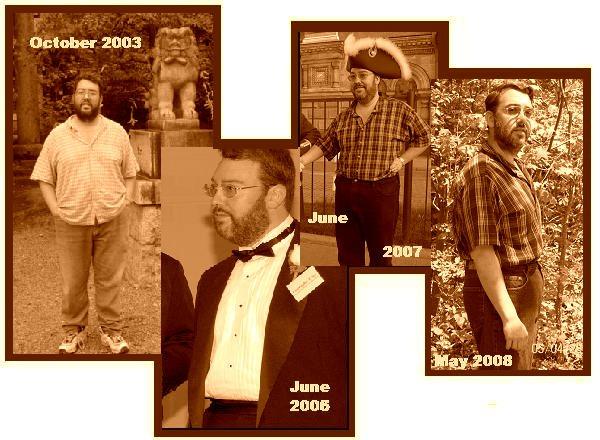
The first picture is a shot of me taken in October 2003 at a Buddhist temple in
The next picture is of me receiving an award in June 2006. The main reason I show this is not to crow, but because it’s a good shot of my girth. I was still near my top weight at this time. You will note that besides the obvious girth my face was very florid and also blotchy from a poor diet.
The third picture is of me in
The final picture is a shot of me in May 2008, which pretty much speaks for itself. This was the first time I was comfortable allowing myself to be shot in profile.
The second image in an actual graph of my weight loss as a function of time, over the past year and three months. Each square represents ten pounds vertically and one month horizontally. The red dots show my actual weight, the dark blue line my goal (note that there were several intermediate goals along the way), the green my revised goal when adjustments had to be made, and the dashed line a trend to see how I was progressing towards my ultimate goal.
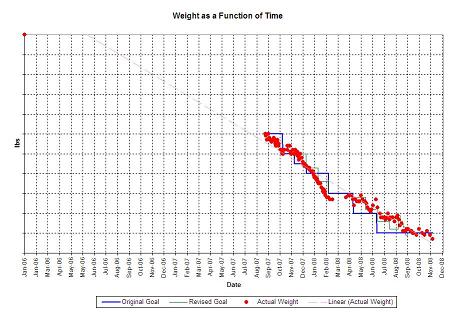
The reason I show this graph is, first, to convince you that my physical transformation is real (and give you a concrete demonstration to encourage you), but also so as to indulge my professorial side and make a few points. Note that my weight declined slowly for the first year and half or so, from the beginning of 2006 to September 2007. Throughout the whole process, I had made a conscious decision to lose the weight slowly, which is the way the experts recommend it be done for permanent weight loss. This will not only give the body enough time to reset its metabolic barometer, but also avoid malnutrition, loss of muscle mass, and loose skin. This weight loss was not done in any systematic way, just with some half-hearted dietary changes and moderate exercise. Once I started to get serious about it, the weight came off in a more disciplined manner. Tracking my weight became somewhat of an obsession, but there was still a period of trial and error in the beginning. You will note there are periods of rapid weight loss, usually following persistently sticking to a lower calorie regimen for a couple weeks, some backsliding, and a few long plateaus. There was a period where my weight would fluctuate between two values, and I’d spend weeks losing a few and gaining a few. Backsliding is normal, but it is also very discouraging. Don’t give up. Each failure is an opportunity to learn, to refine your techniques, and if you stick with it and, over the balance of time, burn more calories than you consume, you will lose weight. Over this time I gradually learned what worked and what didn’t work. You will note that gradually the swings settled down and the rate of weight loss became more or less constant.
There were setbacks even after this trial and error phase – note the gap in March 2008. We were in
What are my credentials for offering you this advice? Do I have a degree in nutrition or psychology? No. Do I have a Ph.D? No. (Well…actually I do, but not in a relevant field.) You’re probably wondering why you should listen to me. Well, I have something far more valuable than a headful of theoretical mumbo-jumbo or a string of impressive letters behind my name. I have the far more impressive credential of actually having done it. I have an advanced degree from the school of hard knocks.
I took an internet poll the other day, one that asked you a bunch of questions about your health and lifestyle and purported to tell you your true age. It said that I’m 29! I consider most of these kinds of thinks rather hokey, but this one I actually believe. When I began my transformation I was old before my time, but now I have turned back the hands of time. I looked old age straight in the face and listened to it tell me my best days were behind me, that my future would be a long, slow descent filled with mounting health problems, and that the world belonged to the young. And I took charge of my destiny when I stared it in the face and said, “I don’t think so. I reject you and all you stand for.” I am younger now than I was in two decades. I am tougher and stronger and wiser than I was when I was in high school. I have recreated myself, and that’s why I use the myth of the phoenix as my personal emblem. Some say life beings at forty, and in my case they’re right.
